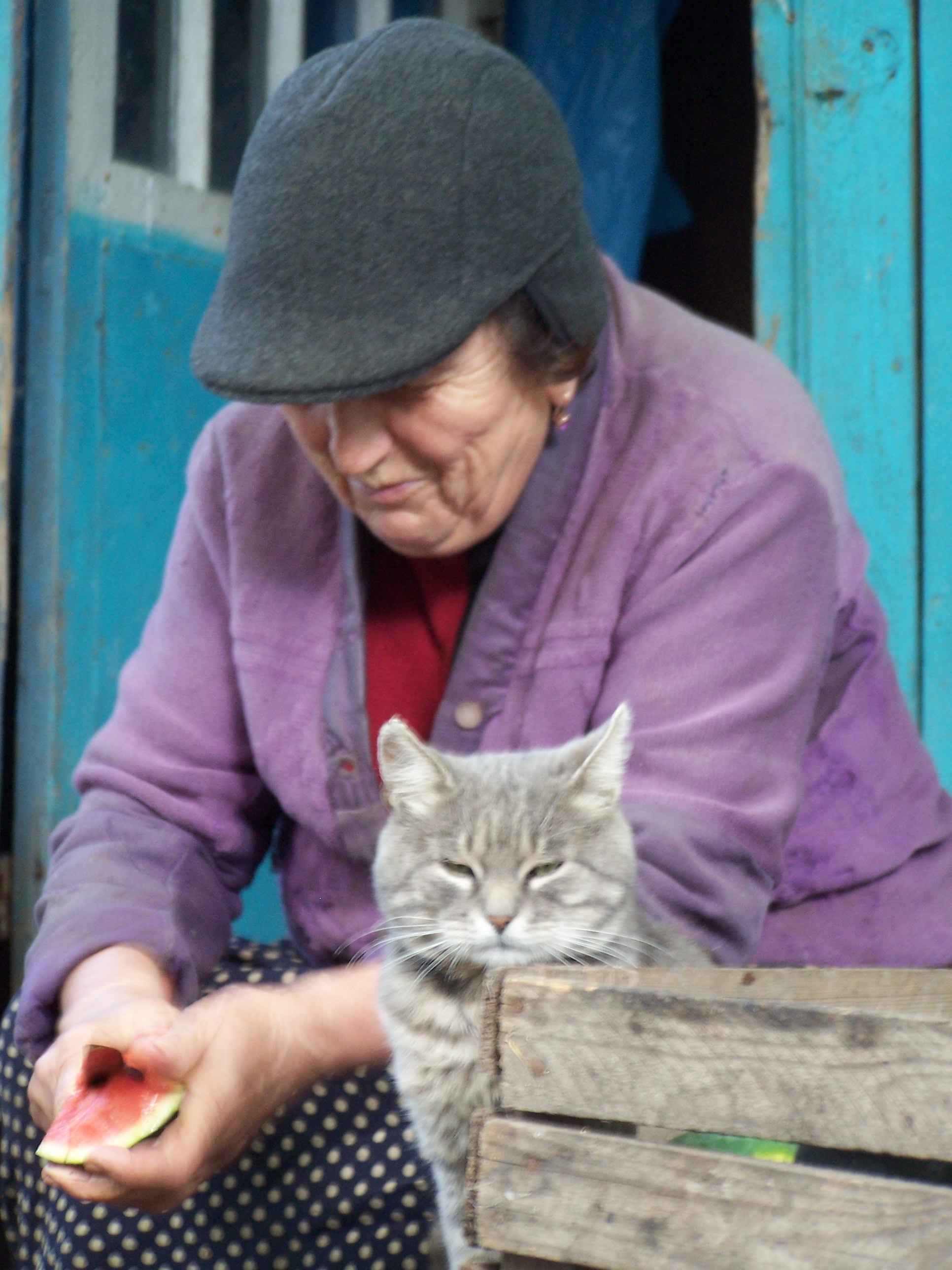
Fearing that a day might come when I look back and remember only the overwhelming love I feel for the stars here and for the sunsets, it behooves me to tell a little bit about the other parts.  About the moments when I’d throw down any card to trade all of this foreignness for my American cubicle and a little consistency. These moments materialize like vacant urges for unusual foods – spring rolls, corn chowder, gefilte fish – and I still haven’t figured out just how to satisfy them without sinking into cynicism.  Ah yes, those wretched waves of cynicism that tempt me to counter a student’s confused and stilted  “I am a bad cold,” with a bittersweet and sharp -  “Yes, yes you are.”

You know you might be a little lonely for affection when the following happens to you on a Sunday afternoon:

You are running your usual route – starting out along the road, lopping away from the two-floor apartment buildings that look like Freshman housing toward the straight snow-covered fields.  Never having encountered anyone else along these roads, you are surprised to see a man open his arms to you as you prepare to cross paths. He wears one of those tall, oval fur hats that so typifies this place and this winter.  The glare from the sun shields his face until you are only a few feet away.  Approaching, for a moment you think that he might be the vice principal’s husband.  You revel in the fact that, once again, you are living in a town small enough to recognize your neighbors. You prepare a friendly salutation and practice it a few times in your head.  But then he smiles and you catch a glimmer of gold in his mouth, notice him totter a bit over the ice and grow mildly suspicious. “Kuda ty begaesh? Where ya runnin’ to?” he asks, invoking the informal, as he opens his arms to reach around for an embrace.

You hardly manage a reply – “Me? That way. Over there” – as you pivot to the left and duck away from his grasp.  And then, as well it should, a mild embarrassment sets in -  because in the hope of some human affection,  you nearly let a perfect stranger,  and very likely a drunk one, give you a good squeeze.

So, there’s that.  And then there’s the inefficiency and the impatience.

This morning, I woke up and ate a piece of chocolate instead of doing yoga.  Maybe that’s the thing that did it. Or maybe it really started last night when I decided to finish watching a horror film instead of falling asleep at 9.  I’m never quite sure what brings on the furrowing brow and loud, weary exhales of frustration. But come they do.

While in pursuit of at-home Internet, my American impatience has been sneaking in.   In order to pay for the modem that I bought yesterday, I had to stand in line for 25 minutes at a kiosk at the bank.  A bank, I’ll mention, that is located on the other side of town from the store that sells modems. I was momentarily struck-  as one would be walking by a particularly creative window display at Bloomingdale’s – by the existence of this middle man whose sole purpose was to collect my shekels.  I saw little value in the “discuss-decide-direct-dally-wait-discuss again-walk back” method  of payment. Decades behind our prized American “swipe and sign.”  And so I made a broad, unfounded conclusion (“You can’t ever get more than one errand done at a time here!”) and I felt a little better.

But I had settled on today being the day that I got to use the internet on my own computer.  After all, three weeks was long enough.  So I puttered around, drank too many cups of coffee and waited for the call with the password to come. I convinced myself, as I sometimes do, that if I made this the central goal of my day – something would come of it. The gods would look fondly at me and my luck would turn and I would be able to browse and surf and Skype to my heart’s content.  So I just sat and waited. All I managed was a soup and a little writing (see below).

And while I’m at it – the airing of these complaints – here’s another one: I have fallen down and bruised the same knee every day for a week. I slip on my way to school, and to the outhouse, and to the bus station.  I may as well be wearing ice skates or glass slippers. And considering the stubborn posture with which I ride the subway handless, it’s a real blow that I can’t even make it down the hill without a Jack and Jill catastrophe.  I have to admit that, during the past week, I’ve let go a bumper crop of mumbled expletives about this place, the ice and the roads and the public works. ” In America,” I gristle, “we salt our streets!”

Tomorrow, I will be able to go back to having no expectations.  I’ll return to the sensible perspective that has made this past month a joy. I’ll get back to the breathing and patience and temperance and goodwill that have made this easy. But today, I am impatient. I am stubborn. I am shaking at the bars of my playpen for someone to bring me apricots. Something, anything, small and round and tasty to brighten my day. In fear of getting all too much wrapped up in myself, I am retreating to the living room for 30 minutes of yoga. I am bringing the chocolate, too.

And then, I hope, I will be able to appreciate the fact that Luba has brought home varekini for dinner and that she’s taken a book out of the public library to help research  strong Ukrainian woman for Yiayia Marge.  I’ll appreciate that it is inevitable: I will fall on my way to the outhouse.  But as I sit there stupidly,  rubbing my knee, I’ll look up and see some milky constellation and remember that this is the moment when I laugh at myself.  This is the moment when I wipe the chicken dung off my palms,  retreat from the wildly barking dog, and get back up again.

It’s a late, swinging Wednesday morning. I’m brushing my teeth and waiting for the kettle to boil. Dust in the Wind hums over the radio waves followed soon after by Bessame Mucho; I suppose it is  “The International Hour.” Because the only sink in our house is located in the kitchen, my Blend-a-med toothpaste sometimes sidles up to the jar of bay leaves. When I wake up in the morning and wash my face, I can hear the sizzle of sunflower oil behind me.   I spit, remember the fish head sitting in the sink yesterday, and turn around to pour my tea.

This isn’t my usual window. But it’s the one that’s closest to the soup I’ve been enlisted to prepare and having yet to break from my urge to multi-task, it’s view will have to do. Usually, I stare out this window at my washing, a brigade of frozen soldiers stiff from the frost, while rinsing lunch dishes and listening to Luba quote Pushkin in the kitchen.  Today, quiet’s set in because school has been cancelled for a few days on account of the cold. I’ll call this a self-imposed ponder – a forced pause from the busying of new embroidery projects, Aryuvedic goals and the uneven meter of deciding to give something a try.

As I raced to finish my run yesterday evening, fearful of being left out in the dark and ice, I couldn’t help but turn around and take a gander at the sunset because I am new to this kind of cold and the way the days ends. It was like this: a swath of pink and oranges shrinking into little, fuzzy rings of purple and silver and gray.  The lower the sun got to the white snowdrifts and the fields between houses, the less color there was. I could imagine someone sucking in all of the warmth, like blowing up a balloon backwards, and leaving only the quietest colors at the horizon line.  The edge between ground and sky looked like lips after too many hours in the pool. The kind of purple that warms up quickly but couldn’t ever be confused for a hot thing.  Purple and completely still – a far cry from the chimneys that puffed out for dear life into the orange sky.  Sliding over the ice patches, willing my fingers to clench together for warmth, to me orange seemed the only color that could make it through winter. These pinks were nice to look at but I could feel the ice crystals forming at their edges.

I stop to see what all the fuss is about on the stove. The grains of rice have expanded to resemble balloon animals, bobbing at the surface and trying to avoid heavy potato neighbors. I add more lemon and some dried dill I spot in front of the window.

It wasn’t just the pinks that looked cold. All of the blues and browns huddled together, forming a frame around the ruddy-faced sunset. I pulled my sleeves down over my gloved fingers. Through my frozen breaths, I could see where there was living going on. To the right, copper hearths reflected from inside houses that shrugged up their shoulders and hunched their heads against the encroaching grey.  I saw, too, a few dark and almost still windows. But even in these places, some brief burnt umber flickered and roared out in a last ditch effort to keep the light.

Again, the gurgling behind me requires attention. Remembering some culinary thing, I add a few spoonfuls of sugar to my yellowish-green soup and survey the results with an oversized ladle.

But shears of wind cutting at my cheeks and at the numbed tips of my fingers were roaring, too. I tried to look at this sunset and this scene like art but my legs were waterlogged and I still had the tower and the old schoolhouse to pass before I turned onto the road home.  I thought of that tired hang you get in museums, when walking by one more Rubens feels like a form of insanity. I longed for the relief of a wooden bench- would have even have settled for a pew. But, then, this wouldn’t be the place to go sitting down for a rest.  Darkening, I could feel the pink frost seizing around my summered muscles as I slowed to a shuffle. It was no longer sensible to be outside.

I turn around to my Wednesday experiment. It is not beautiful but it is almost avgro lemeno and it’ll do.

When I finally came home, the cold, dry, sweat of running at -27C had left me a little sheepish. Still feeling a pulse beating at the edge of my throat, a red face seemed the only physical consequence of my short Shackletonian escapade.  Not a drop of perspiration at the back of my neck or my temples. I shivered and pulled off my sneakers. Sitting down on the bed, undressing my armored body, I felt beat up and cold. I looked at the clock on my computer – 5:03PM and not a lick of light in the sky.

I take faith from the solace that today it’s finally warm enough to snow. I decide to brew myself another cup of instant coffee (a beverage choice I know I’ll have to defend one of these days).  I strike a match swiftly toward myself to light the stove. Quick like the conductor’s snap before the downbeat of that galloping piece about Paul Revere’s ride. Though I don’t expect anything nearly as exciting as that to happen today, I am pleased to have finished my morning chores and managed a half-decent soup.  I am grateful to be done with pondering for a while and glad as anything to be in from the cold.

Finally, I’ve figured out how to fit a little exercise into my new Ukrainian life. And after the onslaught of holiday celebrations, it couldn’t have happened sooner. Though I hardly needed another one, slipping on the snow for forty minutes at a time is, if nothing else, a reason to laugh at myself. Midway through a run last Saturday a little shrimp of a dog started charging me, showing more teeth and froth than I expected for such a small guy. (Now, I’m not sure on which side of the Old Yeller debate I fall, but the fact remains: it’s never fun to have rabies.) Luckily, his owner called him back before he managed to break skin. “Doh-lahr,” she called at him, “idi sudi!” At first, he didn’t respond and continued trotting menacingly at my heels. She called for him again. And this was when I laughed. Because, you have to admit, it isn’t every day that you see a Dollar chasing an American and not the other way around.

Some time soon there’s going to be a war between generations here in Ukraine. You know the kind I’m talking about –like Elvis with his hips, AOL and their chat rooms, hipsters and those jeans. The kind of trend that creates a great gap between generations – the kind of schism that gets written about in textbooks. The kind of thing that has mothers talking in line at the grocery store about ‘kids these days’ and eventually merits a special report on 20/20. In Ukraine, though, I don’t think it’s going to have anything to do with fashion or television programs or music. Most of the Ukrainian adults that I’ve met know more about popular American musicians (Akon, Beyonce and the like) than I do. My babushka’s winter boots are way hipper than mine will ever be and everyone here seems to know how to burn a disc and surf the web. What I think the generation war will be about is simple: mayonnaise. To squeeze or not to squeeze.

Now, this is something that I’ve been trying to figure out for a while. In a country like Ukraine, where everyone races to tell you about the freshness of their produce, where the ketchup is homemade, where they are forever triumphing the miniscule distance from farm to fork, what on earth is something like mayonnaise doing in every dish? The only condiment that sat in my fridge longer was the homemade blueberry marmalade we were keeping for posterity. So, why Mayonnaise? Mayonnaise is the Shetland pony of condiments – no one actually uses it, it just sits in the fridge for show. Sure, we take it out every once in a while when guests stop by for a barbeque, but the rest of time it’s hiding behind the pickle jar, swatting flies with its tail. And so, how exactly, did this happen? How exactly did mayonnaise make the cut?

I imagine the first radio advertisement went something like this:

Are your vegetables too spry? Do you carrots have too much crunch? Your cucumbers too crisp? Is there too much diversity of color at your table? Well, wait no further, because we’ve got just the thing! Mayonnaise. Squeeze on a healthy serving of mayonnaise and watch those bright colors disappear. Instantly, mayonnaise gives you that matte yellowish tinge you’ve been waiting for. And, oh boy, does it pack on the pounds! Don’t delay – pick up a package of mayonnaise at your local grocer’s today. (In the sour cream aisle.)

Ok. So I admit I hold a certain bias here; but it really does seem to be a national phenomena. For example, of the seven kinds of salad on our Christmas Eve table, every single one of them contained mayonnaise. Now, don’t get me wrong. Each one of them (and yes, I tried them all) was also delicious; but, nonetheless, mayonnaise played a pivotal role. I was beginning to think I’d never hear a sour word against the stuff until a few days ago when sitting at lunch with a younger crowd.

“I hardly use mayonnaise,” my Ukrainian friend said, “because, well, you know how bad it is for your health.” And I do know! And so does my friend. So did everyone at the table. But she whispered her knowledge to me as if she were giving up some deep, dark family secret. As if she were afraid to have anyone over the age of thirty hear what she was saying. It was then that I began to theorize.

Could it be that we are now experiencing the last generation of mayonnaise enthusiasts in Ukraine? Has the heyday for whipped eggs and oil reached its apex? Research has yet to show any distinct trends but I have a feeling that one of these days in the very near future we’ll find something else sitting beside the sour cream.

Yes – before we know it, 20/20 will be flashing photos of clogged arteries between commercials for fat-free yogurt and I Can’t Believe It’s Not Butter. Mayonnaise will be a distant memory – like Vienna sausages and Velveeta. I can just see it now. A few more convincing exposes by our friendly newscasters and 100 Calorie snack packs will begin to invade Ukrainian breadboxes. Breakfast will shrink to the size of a Venti latte and subsequently dinner will push the perimeter of a “Grand Slam” platter. Tired from all that overeating after six p.m., people will start driving down the hill for milk instead of walking on foot. With the added traffic, snow will turn gray with soot only hours after it falls. Without the snow’s reflection, the sun won’t provide sufficient light and a nation-wide depression will set it. With folk spending more time at home, consumption of gas and water will skyrocket. And before we know it, there goes the ozone layer.

Of course, if a moratorium on mayonnaise means the end of the ozone layer, I’ll chose the slovenly condiment any day – but I could stand to see a little less of it.  A recent discovery provides hope:

The entire week before Lent, called Maslitsa (or National Butter Week), is dedicated to cooking all our favorite buttery foods.  (Talk about a country who knows how to provide a vehicle for butter.)  So, if nothing else,  least during Maslitsa, I can be sure of less mayonnaise.

I’d like to say that we’ve had a quiet few weeks at school during the holidays but one staff New Year’s party more than made up for the lack of students in the halls. Let’s just say that “Hands up, baby, hands up!” took on a whole new meaning after a little intra-colleague dancing. School starts up again in a week but there is still much celebrating to be done. Orthodox Christmas seems sprung upon us – much like the trap on the dead mouse in our pantry. Mondays, it seems, are Mondays no matter how many legs you walk upon.

Go and find a newspaper. Place it on the table in front of you.

Spread it open like a book. Now, turn the page.

If you are like me, instinct brings a finger to your lip for a bit of moisture to ensure a successful turn. Maybe this brief motion focuses your attention. Maybe, like me, you think there’s something erudite and graceful about it. You probably did it without even thinking. I’ve been watching my Mom do it at the dining room table for years now. My grandparents do it in armchairs in the living room. It’s how we learn to turn a page – especially the thin, grey newsprint kind of page. It’s in our blood – I’d even wager that there’s even a genetic marker on our chromosomes for it.

Recently, however, and for good reason I’ve been compelled to leave the habit behind.

I arrived at the house where I live early in the morning on a Friday. I met my landlady, Luba, and was given a quick tour of the place. I happily put my things down in the dark-green room with all the books. It is a cozy house with tall ceilings and a warm, friendly whisper that travels through every room. But it’s a lot to take in and, like walking into the Museum of Natural History for the first time, you can’t help but turn your head upwards, drop your chin a little, and twist your neck every which way to get a better look. That’s what you get, I guess, when you start hanging Persian rugs like tapestries on the walls. I could have spent all day staring at the patterns on the gold-leafed wallpaper and flowered linens. Having one Grandmother with raised leopard wallpaper in her bathroom and another with bright yellow tiles and stickers encouraging dental hygiene, I found myself unprepared for such bursts of floral in the septuagenarian household.

Equally surprising was the farm out back. I was sitting at the table in the living room in front of a glass of homemade plum wine before I heard any mention of the sixteen ducks and twenty-six chickens in the backyard. I was excited about the chickens. Neither Sea Cliff nor Boston being known for its backyard fowl, this would be a first for me. (Little did I know that a few weeks later I’d be plucking one for the roosters for our Christmas dinner. Less still did I know that I was, at that moment, eating his cousin for breakfast.) It was later on that week, on a backyard excursion to see the birds, that I encountered the outhouse. This was the warmer weather option for relieving oneself and as, on that day, we tipped the scale at a balmy -2 C, its introduction was required. During a brief tutorial, Luba assured me that there was toilet paper and even newspaper – everything I could need. I was surprised about the newspaper but figured that with a little work on my balance I might, eventually, be up to that kind of multi-tasking. ‘When in Rome…,” I reasoned and then smiled to think of all the people around the world squatting on the john and reading the Daily Gazette. Turning around, awash in the poetry of global citizenship, I tripped over a turkey.

In the outhouse was where I found myself a few days ago. After locking the door (read: slipping the thin blade through the crack in the door to catch the latch onto a nail on the other side), I looked over at the shelf for toilet paper and the Daily Digest. And both were indeed there. But it wasn’t the kind of newspaper I was expecting. No NYT or Daily News, though both might at times have sank to the ranks of newsprint suitable for such purposes. Cut into a single square foot pieces, the purpose of the newspaper was to wrap up used toilet tissues for discrete waste disposal. After I’d “done my business” (in the words of Elizabeth Weinstein), I stretched my hand out at the stack of cut squares of newspaper to see just what I had earlier mistaken for a little light bathroom reading. Then instinct chimed in and my hand began moving toward my face. Like a moth to a flame, the force seemed to come from within. Reason, thank God, awoke and saved me from sure disaster. Because if there’s one thing you sure don’t want to do in an outhouse, it’s put your hand in your mouth.

So, what’s my New Year’s resolution? I think the answer is clear. I’m working on drying up. One saliva-free turn of the page at a time.

It’s a hard habit to break, though. Because what’s seems a reprehensible motion in the bathroom is damn effective everywhere else. It’s also what makes me feel like I’m part of my family’s clan. Every time I turn a page, I’m reminded of a few kitchen tables and an endless number of Saturday mornings. Toasted English muffins inevitably play a role. It’d sure be a shame to lose that kind of familial link. And then there’s posterity to consider. This is a habit that’s been with me from cover to cover through math textbooks, classic literature, and (my secret is out) more than a few copies of US Weekly. A moistened turn of the page and, almost instantly, I was ready for whatever was coming. Tangents, a crazy ex-wife living in the attic, another baby for Brangelina? Bring. It. On.

So here we are: It’s 10PM and I’m heading out to try my will. I’ll pull on leggings, then socks, then a sweatshirt and then my winter hat. I won’t bother taking off my nightgown because it’s -15C outside and being considered responsible in Ukraine is singularly related to how warmly you can dress in cold weather. I’ll walk into the kitchen and pull on the rubber boots for walking in the yard. Inevitably, I’ll catch a look at myself in the mirror and understand what made Fargo so frightening. The thought might cross my mind that if I were to write a Young Adult mystery series with this horror in the mirror as the villain, I’d be as rick as J.K. Rowling. But then I’ll remember – I’m no millionaire – just a Peace Corps volunteer trying to saddle up and do it saliva-free.

I’ve finally made it to my permanent site in Eastern Ukraine. Though at present snowbound, it is a beautiful town and the generosity of the people seems to extend farther than every arm’s reach. A real hand-on-your-shoulder-in-support kind of community. I’ve already set up my schedule at school for the new semester. Four days teaching from Monday through Thursday. A handful of after-school activities. And, once transportation is sorted, a few hours at the local orphanage. I am, at last, convinced of permanence.

My first day of school was a trek from beginning to end. (See above: snowbound). But it was the good, Sir Edmund Hilary kind of trek that provides plenty to see from the summit. The day began with thirty minutes walking in -11F weather down the ice luge of a hill where I live. (And yes, this is likely something I’ll use as a retort against the complaints of my future progeny.)

And then the formalities began: I met the school’s headmaster and then was driven into town to meet the mayor. Next, to the district’s administration building to meet the Head of Education. Then, back to school to meet all of the teachers in the auditorium, accept roses on behalf of the staff and try my best to convince everyone in Russian that I didn’t need anyone’s help finding a husband. After sitting in on a few classes (where I was more observed than observing), we sat down for a late lunch with the headmaster in his dining room behind the cafeteria. The room was like many things in Ukraine – a surprise in between expectations.  Tall-backed chairs, a stately china cabinet, and a full-sized fridge! We drank to success, to women, to men, to rich lives, to health. Then I tried tongue for the first time.  Despite its mention here, as a general rule I wouldn’t write home about it.

The chance to sit around a table with a group of educators who had thought so deeply about Ukraine and her position in the world was an honor. Perhaps not quite as high up on the list of honors as Sir Hilary’s but a pleasure just the same.  I listened with as much intention as my three months of Russian study could muster. I added a few words when I could but reasoned that eating tongue was gesture enough. And there, at the apex of the day and at the center of the table, I was granted access to a welcome world of wit, determination, and intellect.

Journeying home, though only a few minutes’ bus trip up the hill seemed a much greater distance. As my counterpart and I waited on the snowy sidewalk, he greeted other passengers. Talk turned to the latest boxing match. Icy roads meant a late bus and temperatures hadn’t risen much since morning. My feet ached from standing on frozen ground, a persistent shiver nudged my patience, but at last the bus arrived. As we boarded the 1973 Mercedes coach model full of electro-plant workers, we entered another world.  Floral patterned curtains stuck to the ice on every window; passengers wore fur hats and heavy Cossack humors; the driver lit a cigarette on a left-hand turn at the top of the hill. My toes tapped to counter the painful defrosting and our dinner table discussion seemed far off.

But I was ever grateful to come home to a warm kitchen and my landlady, Luba. First thing, she wrapped me in a bathrobe and put the kettle on.  I ate some bread and jam. And then we chatted about Chinese medicine. Then, she warmed rye grains to 300F in the oven and put them in a pillowcase to warm my bed. We exchanged a few more songs –hers written in a small notebook that she kept during her medical studies in Kazakhstan, mine written out on scraps of paper strewn here and there in my mandolin case. Then, she read me quotes from Lenin, Lermontova, Maupassant, and Hardy that she had collected over the years.  We got the French-Russian dictionary down off of the shelf and had our second French lesson. And then we realized that though we’d already had our dinner, a concert, a class and an oration, it was only 5:30PM. Half an evening still to fill. But so goes village life on the shortest days of the year.

And now, it’s early on Christmas Eve morning. Just turned 7:00AM and an impatient rooster is crowing in the half-dark. Most mornings don’t allow for such dawdling, but my first class doesn’t start until 9 and I have some time to say a few things.

Sure, my gratitude for the lot of you goes without saying.  (But a few words anyway- in the spirit of it all.)

As I’ve sat patiently listening to everyone’s ideas about Americans (those sly fools!), capitalism (that greedy miser!), and the lost sense of home that some people experienced after the dissolution of the Soviet Union, I thank my stars for Sea Cliff, Boston, New York, Connecticut, Oberlin, Cleveland, Chicago, and St. Louis. Where there might be too much money spent on the wrong things, too much talk of acquiring, too few random acts of kindness, but where I have found the most generous people in any land. Where I have found laughing easiest, listening most enjoyable, minds most activated and free. So, I’ll give this one directive: Creativity, curiosity, self-criticism and self-confidence are characteristics worth hanging on your tree in pride this year. They are tenets of the greatest successes and they are sometimes in short supply. I’ve miles more to go before I manage as much but, rest assured, this Christmas I’ll be planting seeds.  And come to think of it, while you’re decking, make sure to hang the eggnog for me, too.

And now following that bit of (possibly ungrounded) wisdom, I’ll wish all of you the happiest, safest, and most joyful of holidays. May the karaoke machine play all night long, may the tree grow at midnight, and may the world be brighter tomorrow.

Peace.

p.s. The most wonderful gift of all – a fried egg for breakfast. How grand that a fried egg fries just the same no matter where it’s laid. Santa comes through in a clutch yet again!

Tomorrow marks the beginning of our last week of training. It is also our last week of Russian lessons and baking banana bread on Friday afternoons. Gone will be our weekly radio recordings, daily news updates, embroidery sessions and tea breaks. (Huh, didn’t realize I’d joined the D.A.R., here.) At the end of the week, we’ll be tops sent spinning without guidance at long last. Gaining speed as we spring down the stairs, I expect it will be nothing less than a whirling dervish of an affair. In Ukraine, winter is already begun; and though a chill persists, anticipation warms our blood and the push for change feels palpable.

I was never really one for knives and machetes and things. If I couldn’t rip it with my teeth, I reasoned, it probably wasn’t worth cutting. (Which is a frightful thing to say publicly considering the number of dentists that might be reading.) But the only things that I really like sharp are cheddar and wit. I don’t fall in with the whittlers or the woodsmen and I am happy to leave the carving of the Thanksgiving turkey (and the Easter lamb and the Christmas fowl) to somebody else. But this weekend I went to battle with an ax. In this village that I’ve come to know, there’s a long road that leads through the woods to a red-roofed house. At the end of road, there’s an incline – like a roller coaster before its steepest drop. As we walk up the hill, we carry the sort of excitement that says, “Watch out, World, because this morning, we all found the prize in the cereal box.” (Admittedly, this is an easy feeling to find when you are carrying a saw in one hand and an ax in the other.)

There’s just one woman who lives in the red-roofed house and she’s probably in her eighties. There is a 50-foot Ukrainian flag that stands at the crest of the hill behind her homestead and if she told me that she’d made it, I wouldn’t be surprised. If she went on to add that she’d used only silk from silk worms raised in her cellar and that she’d climbed up the 100-foot pole barefoot to hang it, I’d believe her still. Baba Luba, as she is called, is a vision. And she can cut wood with more accuracy than any of us. She uses her hands like they’ve spent decades dressing wounds, generations saving orphans from burning buildings, and a lifetime shucking oysters without gloves. And for all I know, maybe they have. More kindness beams from one of her eyes (as it’s only one she has) than many I know who see with perfect sight. And on Saturday, it was this very same Baba who taught us the art of deconstructing a tree.

The first steps are simple. She points us in the direction of our target. Then, our men stamp out a path and choose the tree up for lumber. The felling takes little finesse but it’s grand fun and after carrying our loot back to the sawhorse, the lesson begins.

The ax wielding, it seems, also afforded me a certain confidence when it came to the scissors in my room the following morning. Waiting for lunch became an infinitely more exciting activity when I decided that there was no great different between the wood and my wet hair. Just a little off the edges. And while few words can express how grateful I am that this impulse was fleeting – I did get a few good cuts in. I figure, maybe I’m warming up to the idea of razing as a requirement for building something better.

You know how they say that Michelangelo saw the statue in the stone as he was carving? I think that, this weekend, a few corners of whatever creation I’m after here seemed to fall into place. Or rather – fall out from it. Which is something, I suppose.  But away, adventure, let dreams roll in for a few hours.

Some moments, I realize that there’s not so much that’s different here. Little girls gulp air trying to keep up with their older, faster brothers.  Old men lean over ledges on their elbows, reaching after a lost feeling of authority. We celebrate in the ways that we know how with the people around us. And if you bake it, it will always be better.

Gutting a pumpkin and making a pie was never something I considered to be a team-building activity; but, as it turns out, it makes a pretty decent one. Too far away to feast on fowl and sop up gravy with a clover roll, we dismembered a pumpkin in remembrance of Thanksgiving. From stem to seed, we skewered, sliced, peeled, cooked and mashed this 14-kilo king of the cabbage patch all afternoon. Without a decent knife around, it felt like taking a butter knife to a bowling ball. But seven sets of able hands made quick work and the end products lived up to our expectations. More impressive, though, is that no one lost a finger along the way. Four pumpkin pies and two pumpkin breads later, the remains of our late November Jack-o-lantern are orange and bright in the fridge.  As we waited on the oven to get everything good and baked, we watched The Office, did a little embroidering, and played a few games a Scrabble.  Which isn’t so far from what I might have done had I been home.  And for that, I’m thankful.

School closures across Ukraine begin their third week tomorrow.  And it is a quarantine that, if nothing else, has done wonders for my embroidery skills.  As I sit here, sipping a glass of birch juice and trying to figure out how to incorporate my name into the bunch of pears I’ve cross-stiched for my host Mom’s birthday, I realize how much I like this place.  How much I’d like to call out and say, “Hey, you. Yea you, Ukraine! Just in case you were wondering – flu or no flu- you are OK in my book.”  And then maybe we’d link pinkies and go and get a plastic cup of Nescafe at the kiosk next to the bus stop. Or something like that.

If I were sitting in a chair during Russian class last Thursday, I would have fallen out of it.  But we tend to spenda lot of time cross-legged on the floor, making up dialgues about our visits to the post office and how to fix a leaking faucet.  We shuffle seats- alternating between one long couch covered with a Persian rug and two similarly adorned chairs along the window.  There’s a mandarin tree in the corner and the landlord comes over every other day to tend to it.  He fills up an empty Kvas cola bottle and waters with the kind of self-importance that is usually reserved for the signers of treaties, presidents, andFacebook profiles.  COme to think of it, we should really try to incorporate him (and his all-gold teeth or “golden smile”) into a dialogue one of these days.

So, anyway I was saved form the fall because I was already on the carpet.  You see, until recently, I wsa a case virgin.  Yes, I’d fuss over a preposition until the cows came home, but I couldn’t name a case for the life of me.  In the languages that I had struggled through,nouns and adjectives did not decline.  There was no talk of tails or suffices or “running” letters. But you are probably much brighter than I n such matters.  You likely know that the Vocative case refers to the way you change the ending of a nount to identify that it is to this noun you are addressing your statement or question.  But I couldn’t ven say that sentence without getting confused.  And I was stuck trying to figure out just why case delcensions were so imortant in the first place.

But wait – a bit of background.

My parents have lived in the same house for nearly twenty years.  I haven’t started measuring my life in decades yet and so, to me, this is a long time.  It’s a regular-sized house in a town that anyone would be happy to call their own.  It’s no Grover’s Corners but who wants a bunch of talking corpses in their cemetaries anyway.  Over the years, we’ve had a lot of different neighbors.  All sizes, all sorts, al creeds.  For most of my younger years, we lived next to a Russian family who had a son named Simon.  Simon was a few years yonger than my brother and me but we all played together.  It was that kind of street.  And whenever Simon wanted my brother and me to play at his house, he’d call over, “Samant, come to my home!”

“SamanTHA,” I’d try to correct him, “My name is Sa-man-THA.” (And if you know me, you can only imagine the way I said this at seven.)

No dice. A good patch of mud brewing in Simon’s backyard and it was, “Samant,come to my home!”

“Samant!” (An especially large colony of pill bugs under a rock beside the hydrangea.)

“Samant!’ (Fresh cookies. Russian cartoons. Tonka trucks.)

 Even after Simon’s family moved to a different part of town, I was called Samant every once in a while.  Mom got a kick out of it but I was less entrhalled by the bastardization of my good name.  And this is the perspective I carried with me until last Thursday when, as mentioned,conversation fell to the vocative case.

“You get it,” a fellow classmate said, “like if I were addressing YOU and I wanted to make sure that you knew it, I’d say- Samant, have a biscuit.

And then, suddenly for the first time in two months, I feel like I understand Russian completely.  It is awesome and, almost instantly, I want to know where Putin is because I have a few questions to ask him about that Siberian tiger he took down last August and, well, if not now…

WHen my excitment settled, I realized that what I had so eruditely identified at seven as a foreigner’s mistake was actually a rather impressive use of Old Russian grammar.  It wasn’t a funny accent that had my five-year old neighbor  calling at me in disyllabic urgency but the vocative case.  Simon wasn’t confused about my name; he was simply emphasizing that he was talking to me- Samant.  I spent the rest of class in a state of extreme satisfaction akin to fitting the last piece of pizza into a Tupperware, zipping closed an overstuffed suitcase, or successfully stamping your foot into a ski boot.

I have since gotten into the habit of thinking myself something of an expert on the vocative case. (Perhaps there is more of that misinformed seven year-old grammarian in me than I’d like to admit.) And as I sit on a bed across from the baking oven in a small Ukrainian kitchen and hear my host Dad call out “MA!” from the other room, I just smile and shake my head.

And then, as if I’ve always known, I watch babushka pick up the chicken to bring into the other room and I sigh, “Oh, there’s that old Vocative again.” And then we all sit down to lunch where, just in case I’m feeling too confident about my language skills, the Ukrainian starts up again and I’m lost entirely.

So, I stick with what I know and, looking down at my plate, shrug and whisper, “Well, Chick, I guess it’s just you and me.”

Sometimes I feel that if I were to weigh every Russian word I know on a bathroom scale, the arrow would jiggle in that way that it does and then settle back again at zero.  In my vocabulary there is one word for cold, for tired, for work, and for beautiful.  My dictionary is about the size of a box of ktiches matches (the upside is that I can say that in Russian).  I consistently confuse the word for “person” with the word for “garlic”- which complicates things if you are sauteing.  During this first month of Russian study, I have been freed from the carapace of poetics.  And let me tell you literal is the new black.

One of these days, following the exposed hot water pipe that stretches form the school where I teach to my host family’s apartment, it will all be old news.  The walk will be just another part of my plucky, plumthumbed everyday life here in Ukraine.  But right now, I am marveling.  Every time I walk by the water pipe, I watch a black cat nestling in the torn insulation.  I count mullets and open beer containers on my walk from the bazar. I bristle at the full-throttle, gutteral groan of teenagers flooring Ladas in back alleys.  My kids, I vow, will learn how to feather a clutch if it kills me.  I ponder the taste of goose and rabbit in the dumplings at dinner.

And then there are the marshrutkas.

The marshrutka is the lingua franca of local transportation here in Ukraine.  No doubt if you’ve every visited or lived in a former Soviet country or traveled around Latin America or the Indian subcontinent, you’ve encountered one of them.  Or perhaps it is more accurate to say that if you’ve seen one, you’ve seen a hundred.  They are of no particular ilk, color or style.  They may have four wheels or six; one door or three.  In fact, they might be most accurately identified by their inability to fall into a single category of automotive vehicle.  Retired school buses, minivans, construction trucks, coaches, all can be found and reincarnated on the road.  If they one day banned together and created a world enterprise, they would operate under the slogan: These Wheels Will Take You Anywhere.”  Heck.  If they were to buckle down and really get creative, they might come out with a bumper sticker.

And today, being no different from yesterday or tomorrow, I heard one of these marshrutkas pop and putter out while driving up the hill that leads into town.

Huh, I mused, so that’s what that sound is.

And then I went back to thinking about how my friend in Cleveland would be just devastated to see all of these earthworms drowning in the puddles of recent rain.  Figuring that some well-trained technician would alight, kick at the front bumper and get the van started again, I kept on up the road.  After deciphering a billboard advertising plumbing facilities up ahead, I looked back and saw the dark blue van, dejected, rolling back down the hill and into the shoulder.  I tried for the next billboard and got lost in translation somewhere between beach and electric kettle.

Then I looked to confirm whether or not the passengers had at least made it off the bus and out of the road.  No sooner did I turn around than was I confronted with the Little Engine That Could incarnate cantering up the hill past the broken-down bus.  A farmer and his haying tailer were gaining on the mislaid travelers like a metronome.  They grey horse that pulled the whole contraption made me want to sing Christmas carols, drink Budweiser, and watch National Velvet all at the same time.  Seeing the passengers marching up the hill on foot, I figured that the marshrutka couldn’t be blamed entirely for living up to its etymology.  The farmer, seated at perfect height for surveying the demise of modernity, continued on without so much as a spit sunflower seed.

The farmer made it up the hill first but I’ll still stand behind the marshrutka. Pawns fall too, but ah, could we ever capture a king without them.

Soon enough, I guess, I’ll start to understand all of this.  And maybe I’ll pause from the marveling for a while.  For now,  I am still waiting for the moment when I become more person, less penmanship.  And wouldn’t it be something to write a love letter in Russian.

These first few weeks we are bound by host families and tied to regulations.  We are foreigners at first sight – temporary visitors who speak in pigeon-tongues and hand gestures.  Every night, we nest and study until the tide of sleep comes in.  Then, we wake and preen and shrug on our brightest colors and tallest shoes.  We cross streets, buy groceries, and barter in packs.  We are in view, always.  And still, somewhere within this foreign limelight, routine has claimed its side of the bed and settled in.

Lately, I’ve been visiting the local stadium after Russian lessons.  It is my best attempt at independence. Every day, I rush home as if to catch the bus for a late Fall field hockey game.  Then, I go and blow the stink off before the sun sets.  The track, rows of blue bleachers, basketball courts and a parking lot make this stadium something of a Mecca for the sports-minded.  Boys play soccer in a cube-like cage turned practice pitch.  A few others toss a basketball at a net-less hoop.  On most days I am the only runner and when I do have company, it is one of my fellow volunteers.

On the commute to the stadium, I see teachers, blue plastic bags full of fresh fish in hand, marching home to second jobs and lazy husbands or dinner preparations.  Teenagers saunter over to the computer club where they watch YouTube videos and learn how to be cool.  Men walk back from kiosks setting packs of cigarettes and spitting sunflower seeds.  At four o’clock everything is in motion.

One day last week, decked out in our finest American sports gear (read: PadaGucci,  North Face, Nike) we walked toward the stadium.  Prattling on about our favorite American news sources and the habits of our host families, we were reveling in a few hours’ freedom from a busy schedule.  We passed around our bits of World News like chewing gum or hand cream. Hillary hits up Moscow. Obama Hooks a Big One. Yankees Sweep.  And then, at the road’s incline and just after some brief mention of Beyonce, we found ourselves apace with a Ukrainian funeral procession.  Half a hundred mourners, following an open casket, beat their grief in slow, metered stepsup the hill.  Bright wreaths of flowers swing from the coffin as six men carry it slowly up the incline.  Our own bright colors ring out like cell phones during final exams and we put our heads down and, quick, walk on.

And though I resented my sneakers for squeaking as we power-walked past the procession and, I admit, it was mildly reminiscent of that nightmare about being naked in public, it was familiar too.  I mean, we’ve all walked our dead and I suppose the reverence with which we bid farewell is a universal thing.  We keen, we cry, we drink, we raze, we ululate; no matter how we walk it is rough terrain.

Two days later, skipping down step toward the stadium, I pass an old man grazing two goats in the periphery by the parking lot.  He has the sort of face that is frightening on 48th Street but wise and kind away from home.  Twenty feet below, the local kids are practicing free throws.  And there we are, all of us, keeping to our routines.

I catch a few odd stares as I curve around on my first lap.  But today, two high school soccer teams are playing on the pitch and I get to be a fan again.  I toss a lost ball back to a player.  I survey the field for superstars.  I look for good defensive positioning.  The home team scores and it takes every ounce of restraint to keep from cheering them on.  But being a visitor, not yet fluent in this language or this place, I keep quiet and lean into the next turn.

Next Page »